posted in
The Source-Bounded Research Brief: Make Deep Research Show Its Work
Control the plan, sources, evidence, and uncertainty before accepting a research conclusion.
Tip
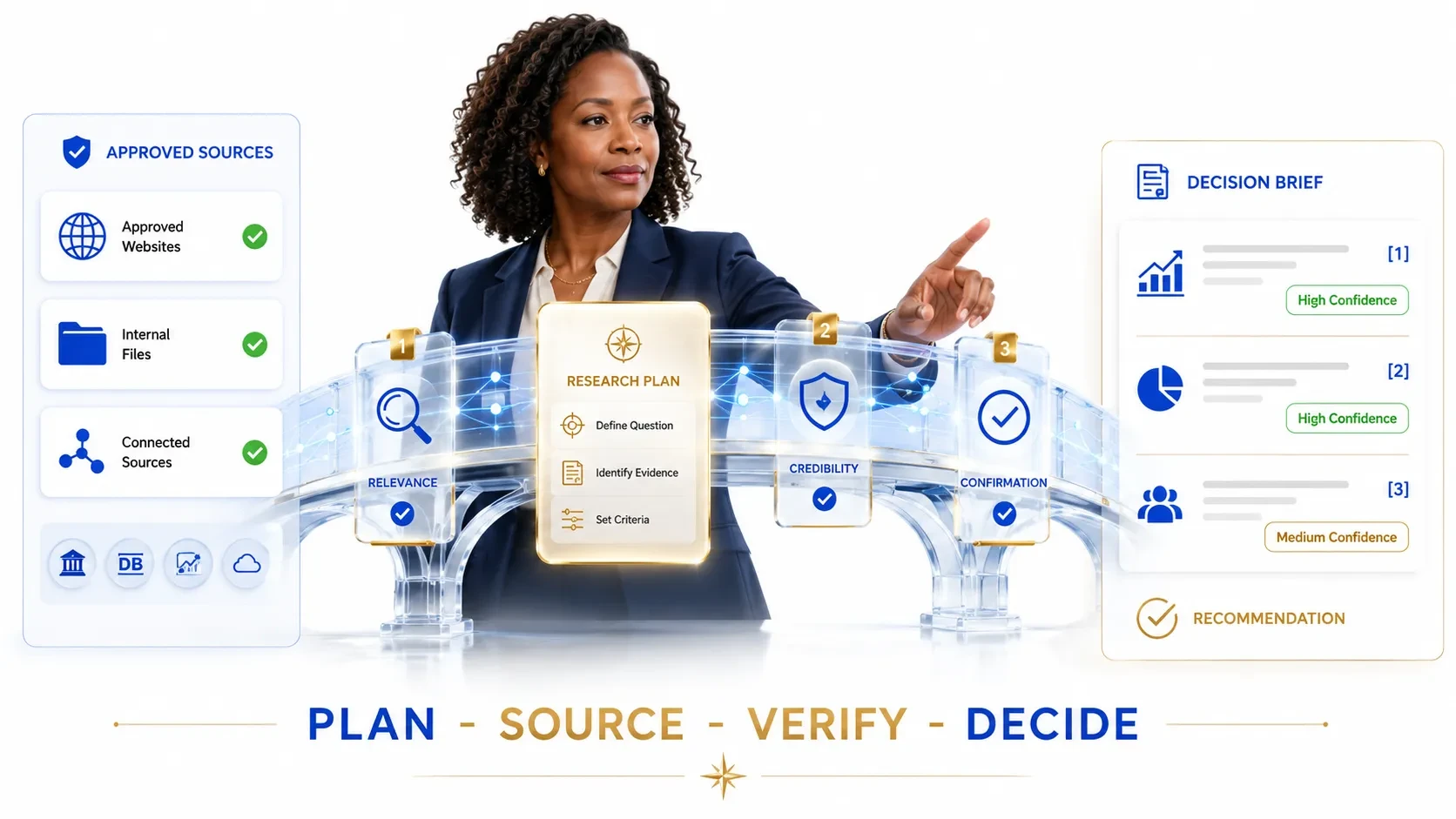
Use ChatGPT Deep Research for questions that require multi-step synthesis rather than a quick lookup. Define the business decision first, then specify the public sites, uploaded files, and connected apps the research may use. Review and edit the proposed research plan before it starts. Require an evidence ledger that separates sourced facts, calculations, interpretations, disagreements, and unknowns. When the report is complete, verify the highest-impact claims through the citations and export the result for review, annotation, or sharing.
Why It Matters
Business leaders often spend hours collecting information and still end with a document that hides assumptions. Deep Research can accelerate the collection and synthesis work while preserving a visible source trail. The key is to define the decision, source boundaries, and verification standard before the research begins. This turns research from an impressive narrative into a reviewable decision asset.
Business Impact
Measure the full research cycle: scoping, collection, synthesis, verification, and decision preparation.
· Planning estimate: reduce 3-8 hours of manual collection and first-pass synthesis for a complex market, policy, vendor, or customer question.
· Improve decision confidence by exposing source quality, disagreement, assumptions, and missing evidence.
· Reduce duplicate research by exporting a documented brief that others can review and reuse.
· Lower risk by restricting research to approved domains or connected sources when credibility matters more than breadth.
Three Specific Use Cases
Small Business: An SMB owner evaluates three expansion markets using official demographic, labor, competitor, and local economic sources, then requests a recommendation conditioned on specific assumptions.
Enterprise: A strategy team compares emerging regulatory requirements against internal policy documents and approved external sources, with a gap table and named evidence owner.
Personal Productivity: A professional researches a certification or career transition using official program sites, current job requirements, personal files, and a cost-time-return comparison.
Example
A leadership consultant was preparing a paid briefing on how mid-market firms were using AI in customer service. A normal web search produced repeated vendor claims and weak statistics. The consultant used Deep Research with a source hierarchy: government and academic research first, public company filings second, respected industry research third, and vendor material only for product claims. The final report included a disagreement table and an evidence ledger. Preparation time fell from an estimated full day to three hours of scoping and verification, and the consultant removed four claims that were well cited but not strong enough for the audience.
Ready-to-Use Prompt
Use Deep Research to create a decision-ready brief.
BUSINESS DECISION
[WHAT DECISION WILL THIS RESEARCH SUPPORT?]
AUDIENCE
[DECISION MAKERS / CLIENT / TEAM]
RESEARCH QUESTION
[PRECISE QUESTION]
SOURCE RULES
Prioritize:
1. [OFFICIAL / PRIMARY SOURCES]
2. [TRUSTED SECONDARY SOURCES]
3. [CONNECTED INTERNAL SOURCES]
Exclude or clearly label:
- Sponsored content
- Undated pages
- Anonymous claims
- Sources older than [DATE] unless historically necessary
SITES OR DOMAINS TO RESTRICT OR PRIORITIZE
[LIST]
REQUIRED ANALYSIS
- Current state
- Major options
- Evidence for and against each option
- Cost, time, risk, and likely benefit
- Areas where credible sources disagree
- Assumptions and missing evidence
- Recommendation with conditions
- Small reversible next step
BEFORE RESEARCH
Provide a proposed research plan with:
- Workstreams
- Intended sources
- Exclusions
- Clarifying questions
- Expected limitations
Wait for approval before proceeding.
FINAL REPORT REQUIREMENTS
1. Executive summary
2. Findings with citations
3. Evidence ledger: Claim | Source | Date | Source type | Confidence | Verification status
4. Disagreement and uncertainty table
5. Recommendation with conditions
6. What a human expert must validate
7. Sources used
8. Research activity summary
Do not convert an inference into a fact. Clearly label estimates and calculations.
Pro Tip
Run two passes. First, ask for the strongest supported answer. Second, ask Deep Research to challenge its own conclusion: find disconfirming evidence, alternate explanations, source concentration, and assumptions that could reverse the recommendation. For high-value work, assign a human owner to verify the five most consequential claims rather than checking every sentence equally.
Common Mistake
The common mistake is asking for broad research such as "tell me everything about this market." That produces volume without a decision standard. Define the choice, audience, timeframe, geography, source hierarchy, and exclusions. The second mistake is treating citations as proof. A citation can be current and still be biased, weak, circular, or irrelevant to the specific claim.
Measure Success
· Research cycle time from approved question to verified brief.
· Critical-claim verification rate: percentage of high-impact claims checked against the cited source.
· Decision usefulness score from the intended reader: clear options, tradeoffs, assumptions, and next step.
Avoid Using This When
Use standard search for a quick current fact rather than spending a limited Deep Research task. Do not rely on Deep Research alone for legal, medical, financial, employment, safety, or regulated decisions. Do not connect sensitive repositories without an approved data-handling model, least-privilege access, and an understanding of retention and workspace controls.
Best Tool For
ChatGPT Deep Research is strongest when a question requires synthesis across the public web, uploaded files, specified sites, and enabled apps with a documented report. NotebookLM is often stronger for analysis that must remain inside a fixed source collection. Standard ChatGPT search is faster for a quick current answer. The right tool depends on whether the priority is breadth, depth, or closed-source grounding.