posted in

The Research Plan You Approve Before the Report

Use Gemini Deep Research to combine current web evidence with approved Gmail, Drive, and uploaded sources without blending fact, opinion, and assumption.

Tip

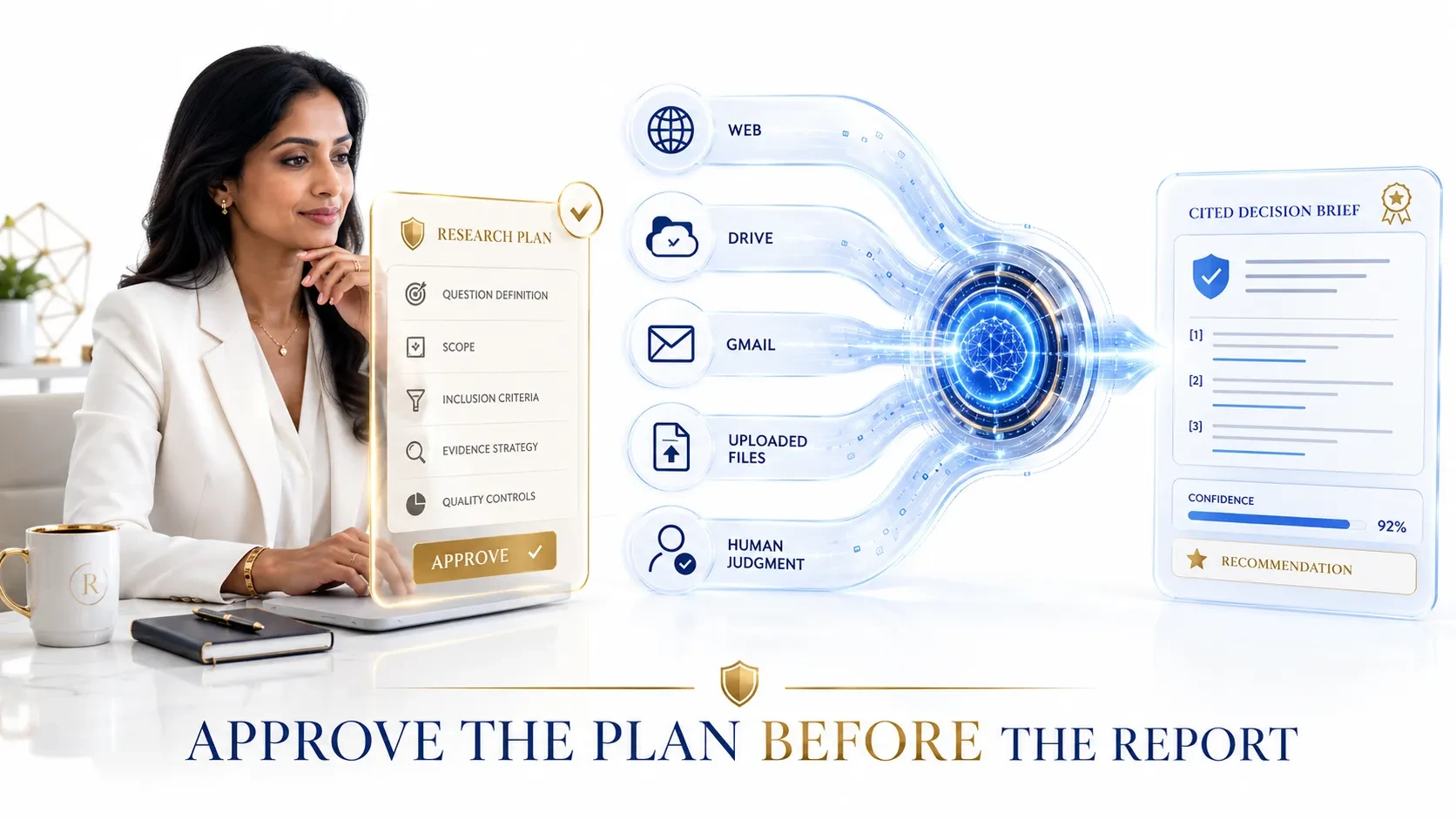
Start Deep Research with a decision question, not a broad topic. Select the sources Gemini may use, such as Google Search, approved Drive files, relevant Gmail, or uploaded documents. Review and edit the research plan before execution. Require a source register with date, publisher or owner, evidence type, and relevance. Tell Gemini to separate external evidence, internal evidence, interpretation, assumption, and recommendation. Ask for contradictory findings and missing evidence, then run a second pass that challenges the leading conclusion. Keep the final recommendation owned by a named human decision maker.

Why It Matters

Research reports can look authoritative while hiding weak source selection, stale internal data, or untested assumptions. Gemini Deep Research creates value when the organization controls the question, source boundary, plan, evidence classes, and approval point. That makes it useful for market scans, partnership decisions, proposal research, policy comparisons, client briefings, and strategic planning without treating AI-generated synthesis as unquestioned truth.

Business Impact

Compare one research brief produced with an approved plan against the current manual or ad hoc process.

·    Planning estimate: reduce initial research and synthesis time by 2-6 hours for a bounded executive brief.

·    Improve decision quality by exposing conflicting evidence, source dates, and unknowns before recommendations are accepted.

·    Reduce rework by aligning stakeholders on the research question and plan before collection begins.

·    Lower citation risk by requiring a traceable evidence register and human verification of the most important claims.

Three Specific Use Cases

Small Business: A consultant researches three target industries using current market sources plus approved Drive documents that describe the firm's capabilities and existing clients.

Enterprise: A strategy team compares regulatory, competitor, customer, and internal operating evidence before recommending a market-entry pilot.

Personal Productivity: A coach researches current workforce trends while keeping private client notes excluded and using only de-identified program themes as internal context.

Example

A boutique advisory firm previously spent two days assembling a market-entry brief from web searches, old slide decks, and scattered emails. The principal used Deep Research with Google Search, three approved Drive files, and one current internal email thread. She edited the research plan to exclude consumer blogs, require sources from the past 18 months where possible, and include disconfirming evidence. The first draft took under three hours of total human effort. During review, the team rejected two weak claims, corrected one stale internal assumption, and delayed the recommendation until a customer interview closed the largest evidence gap. The time savings mattered, but the visible uncertainty produced the better decision.


Ready-to-Use Prompt

Run a governed Deep Research process for this decision.

DECISION QUESTION
[ONE SPECIFIC BUSINESS DECISION]

DECISION OWNER
[NAME / ROLE]

APPROVED SOURCES
- Google Search: [YES / NO]
- Google Drive: [SPECIFIC FILES OR FOLDERS]
- Gmail: [SPECIFIC THREADS, PEOPLE, OR DATE RANGE]
- Uploaded files: [LIST]
- Excluded sources: [LIST]

SOURCE STANDARDS
- Prefer primary and authoritative sources.
- Record publication date and evidence date separately.
- Flag sources older than [TIME WINDOW].
- Do not treat marketing claims as independent validation.
- Do not infer internal facts that are absent from approved sources.

BEFORE RESEARCH
1. Restate the decision question.
2. Propose a research plan with workstreams and source types.
3. Identify likely evidence gaps and bias risks.
4. Wait for my approval or edits.

REPORT STRUCTURE
1. Executive summary
2. External evidence table
3. Internal evidence table
4. Conflicting findings
5. Assumptions and unknowns
6. Options with benefits, costs, and risks
7. Recommendation with confidence level
8. What would change the recommendation
9. Human decisions still required
10. Source register with direct citations

RED-TEAM PASS
Challenge the leading recommendation. Search for disconfirming evidence, alternative explanations, and stakeholder impacts that may have been missed.

Do not make the final decision. Present evidence and a decision-ready brief for the named owner.


Pro Tip

Ask Gemini to maintain a claim ledger containing claim, evidence, source date, confidence, counterevidence, and human verifier. Have the decision owner sign off on the five most load-bearing claims before the brief is distributed. This turns citation review into an operating control rather than a last-minute proofreading task.

Common Mistake

The common mistake is asking for “everything about” a market or topic. The result may be broad but not decision-ready. Another mistake is mixing personal Gmail, organizational Drive, public web sources, and uploaded files without stating which source class has authority. Define the decision, approve the research plan, limit access, separate evidence classes, and verify critical citations.

Measure Success

·    Human research and synthesis hours per completed decision brief.

·    Critical-claim verification rate and number of corrected or rejected claims before distribution.

·    Decision cycle time from research request to approved next step.

Avoid Using This When

Do not use Deep Research as a substitute for legal, financial, medical, regulatory, or security review. Avoid connecting personal or organizational sources without authorization and a clear need. Do not rely on a report when the evidence is highly time-sensitive, inaccessible, or dominated by unverifiable claims. Escalate material uncertainty to the responsible expert.

Best Tool For

Gemini Deep Research is especially strong when the workflow benefits from Google Search plus approved Gmail and Drive context and the user wants to review the research plan. ChatGPT Deep Research is a strong alternative in an OpenAI environment. Claude Research can be effective for web and connector-based synthesis. NotebookLM is often better when the task must stay tightly bounded to a curated source set and evidence navigation is more important than broad web research.

The Research Plan You Approve Before the Report

posted in

The Governed Gem: Turn Your Best Method into a Reusable AI Teammate

Use custom Gems to preserve approved instructions, reference files, terminology, and human-review rules across recurring work.

Your methodology should not be rebuilt from memory every time someone opens a new chat.

Tip

Create one custom Gem for one repeatable business workflow, such as discovery preparation, proposal quality review, client debriefs, content repurposing, or workshop design. Give the Gem a narrow purpose, explicit inputs, approved source files, output requirements, prohibited actions, and a human-approval step. Add only current knowledge files from your device or Google Drive. Keep knowledge citations enabled when traceability matters. Test the Gem with ordinary, incomplete, contradictory, and adversarial requests before sharing it. When the workflow is used inside Google Workspace, the same Gem can appear in the Gemini side panel, allowing approved guidance to travel with the work instead of living in a separate prompt document.

Why It Matters

Coaches, consultants, and small-business teams lose time and quality when each person interprets the same process differently. A governed Gem reduces repeated briefing, protects terminology, and turns a proven method into a reusable operating aid. The goal is not to create a digital clone of the expert. The goal is to standardize the repeatable portion of the work while preserving judgment, client context, and final approval for the human owner.

Business Impact

Pilot the Gem on one recurring deliverable for four weeks and compare the results with the prior manual process.

·    Planning estimate: save 20-60 minutes per repeated task by reducing re-briefing and source gathering.

·    Improve consistency by using one approved method, vocabulary, output format, and review checklist.

·    Reduce intellectual-property leakage by limiting the Gem to the minimum source set and sharing it deliberately.

·    Shorten onboarding time by giving collaborators a tested workflow rather than a folder of prompts and examples.

Three Specific Use Cases

Small Business: A woman-owned consulting firm creates a Proposal Quality Gem with its approved scope checklist, differentiators, case-study language, pricing guardrails, and risk-review rules.

Enterprise: A learning team creates a Training Design Gem that uses the organization's instructional standards, accessibility requirements, approved templates, and review checkpoints.

Personal Productivity: An executive coach creates a Session Preparation Gem using de-identified client goals, approved coaching questions, and the coach's own framework while keeping confidential notes outside the Gem.

Example

A career consultant spent about 70 minutes preparing each client strategy summary because she repeatedly searched for intake answers, service standards, and preferred language. She created a Gem with her approved assessment rubric, deliverable template, terminology guide, and a rule that separated client facts, consultant interpretation, and recommendations. She tested ten cases, including missing intake data and conflicting goals. Preparation fell to roughly 30 minutes, and first-review corrections dropped from an average of eight to three. She still approved every recommendation and did not upload raw sensitive records.

Ready-to-Use Prompt

Create a custom Gem for this governed workflow.

GEM NAME
[NAME]

BUSINESS PURPOSE
Help [AUDIENCE] complete [ONE RECURRING WORKFLOW] with greater consistency and less preparation time.

AUTHORIZED INPUTS
- [CURRENT APPROVED SOURCE 1]
- [CURRENT APPROVED SOURCE 2]
- [TEMPLATE OR CHECKLIST]
- Information supplied in the current chat

SOURCE RULES
1. Prefer approved source files over general knowledge.
2. Identify which source supports each material claim.
3. Mark missing, stale, or conflicting information as NEEDS CONFIRMATION.
4. Never invent client facts, metrics, citations, commitments, or policy.

WORKFLOW
1. Restate the requested outcome.
2. Confirm the required inputs.
3. Ask no more than five clarifying questions.
4. Produce the deliverable in the approved structure.
5. Separate FACT, INTERPRETATION, ASSUMPTION, and RECOMMENDATION.
6. Run the quality checklist.
7. Present approval questions before finalization.

PROHIBITED ACTIONS
- Do not make legal, medical, financial, hiring, credit, or other consequential decisions.
- Do not expose proprietary methods or confidential information beyond the requested output.
- Do not send, publish, schedule, or commit anything without explicit human approval.
- Do not merge information from different clients or engagements.

QUALITY CHECK
- Correct client and scope
- Current sources
- Approved terminology
- No unsupported claims
- Clear human-review points
- Final open-questions list

TEST BEFORE SHARING
Run normal, missing-data, conflicting-data, out-of-scope, prompt-injection, and sensitive-data tests. Show the results and unresolved risks.


Pro Tip

Create a one-page Gem Control Sheet with owner, purpose, source list, effective date, version, test cases, permitted users, and next review date. Keep a small golden test set and rerun it whenever instructions or knowledge files change. If the Gem is shared, use the minimum permissions required and verify what recipients can see, edit, or copy.

Common Mistake

The common mistake is creating one oversized Gem for every business task. Broad instructions create inconsistent behavior and make quality difficult to test. Another mistake is uploading old files, confidential records, or intellectual property without reviewing account type, data protections, permissions, and business need. Keep the Gem narrow, curate sources, preserve citations where useful, and assign a human owner.

Measure Success

·    Average preparation and execution time per repeated workflow.

·    First-pass acceptance rate against the approved quality checklist.

·    Defect rate caused by stale sources, unsupported claims, wrong terminology, or cross-client context.

Avoid Using This When

Do not use a Gem as the final decision maker for high-consequence work or as the system of record for confidential client data. Avoid sharing a Gem before testing permissions, source exposure, and recipient behavior. Do not assume a grounded answer is correct simply because it references a file; source owners must verify currency and authority.

The Governed Gem: Turn Your Best Method into a Reusable AI Teammate

You've reached the end of the posts