
posted in
Sign up for Manus
Sign up here (Full Transparency, I get 500 points)

posted in
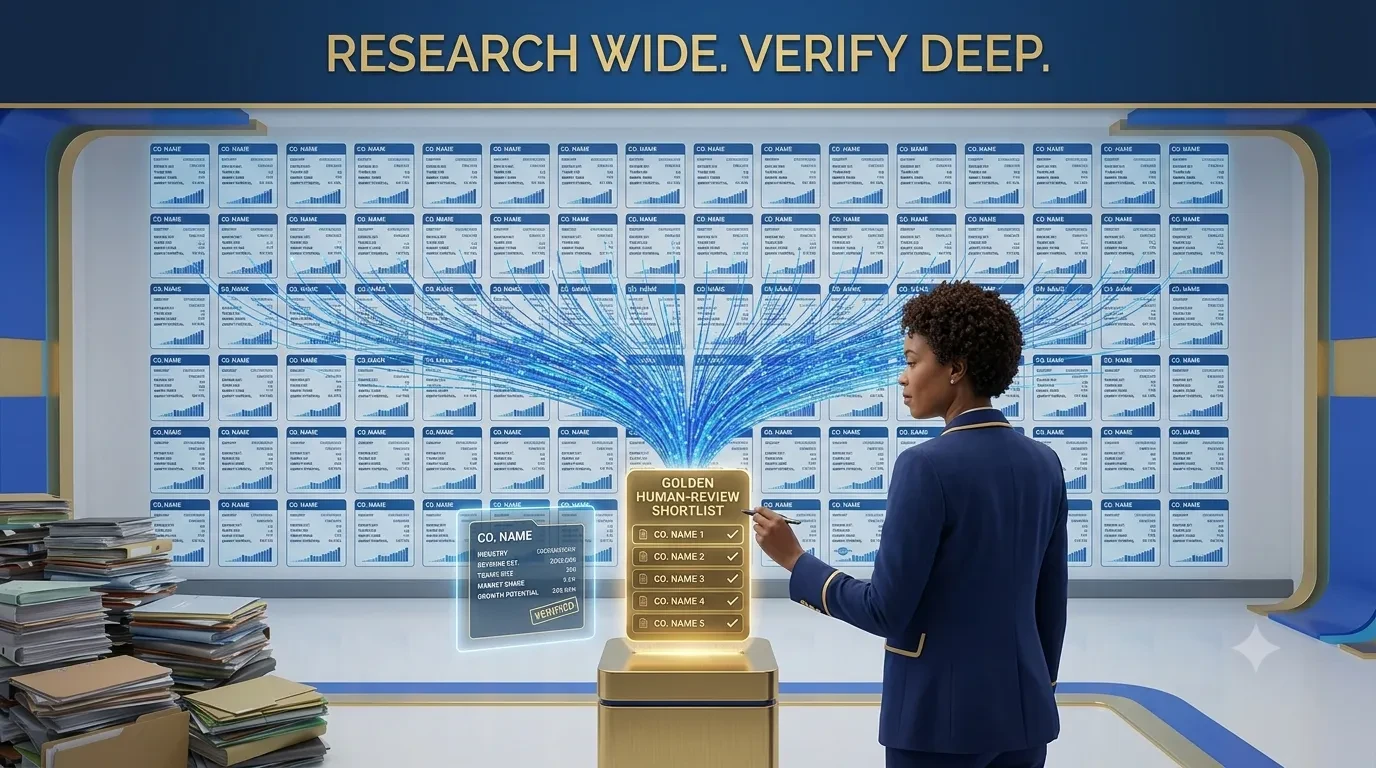
Use Manus Wide Research to evaluate dozens or hundreds of independent items against one approved schema, then verify the shortlist before action.
Your research should not become shallower simply because the list became longer.
Use Wide Research only when the assignment contains many independent items, usually ten or more companies, products, grants, associations, papers, or prospects. Define the evaluation schema before the run: required fields, acceptable sources, freshness window, scoring rules, evidence links, confidence, missing-data treatment, and output format. Pilot the schema on five items, review the result, then scale. Separate discovery from qualification: first build the complete market map, then have a human verify the highest-value candidates and decide what action is appropriate. Never treat scraped contact data, rankings, or AI-generated scores as automatically accurate or ethically usable.
Traditional research workflows lose consistency when one analyst works through a long list sequentially. The first ten profiles may be detailed while the last thirty become rushed. Manus Wide Research is designed for large sets of similar, independent items by assigning them to parallel agents and synthesizing the results. The business value is not 'more research.' It is a structured decision dataset that allows an SMB owner, coach, consultant, or enterprise team to compare the same evidence across every candidate and focus human judgment on the shortlist.
Run one bounded market-mapping pilot and compare it with the prior spreadsheet-and-search process.
· Planning estimate: save 6-15 hours when profiling 50-100 independent items against a stable schema.
· Improve comparison quality by requiring the same fields, source standards, scoring rules, and missing-data labels for every item.
· Reduce decision cycle time by moving from an unstructured list to a ranked, filterable dataset with evidence links.
· Lower reputational risk by verifying the shortlist and separating research findings from outreach, purchasing, hiring, or investment decisions.
Small Business: A woman-owned advisory firm maps 75 regional associations, accelerators, and conference organizers to identify five partnership channels aligned with its expertise.
Enterprise: A procurement team compares 100 software vendors using security evidence, integration fit, pricing model, customer segment, and implementation risk before inviting a smaller set to formal review.
Personal Productivity: A coach evaluates 30 speaking opportunities by audience fit, submission deadline, travel requirement, honorarium, topic alignment, and evidence quality.
A boutique cybersecurity consultancy had a list of 84 potential channel partners but no consistent way to evaluate them. The founder used Wide Research with a fixed schema covering customer segment, geography, service overlap, partner program, recent activity, source date, and evidence strength. She piloted five organizations, corrected two ambiguous scoring rules, then ran the full list. Manus returned a structured table and flagged 17 records with weak or missing evidence. The team manually verified the top 12, selected four for personalized outreach, and cut the initial research effort from roughly two workdays to one afternoon. The shortlist still belonged to the founder, not the model.
Create a governed Wide Research market map.
BUSINESS DECISION
[ONE DECISION THIS RESEARCH WILL SUPPORT]
ITEM SET
Analyze all [NUMBER] items in [LIST / FILE / URL SET]. Each item is independent.
APPROVED SOURCE STANDARD
- Prefer primary sources and current official pages.
- Record source URL, publisher or owner, publication/update date, and access date.
- Flag information older than [TIME WINDOW].
- Do not infer a fact that is not supported by evidence.
- Label missing fields as NOT FOUND, not as zero or no.
REQUIRED FIELDS
1. Name
2. Category
3. Relevant offering or capability
4. Target customer or audience
5. Geography
6. Price or business model, if publicly available
7. Evidence of recent activity
8. Risks or disqualifiers
9. Source links
10. Confidence: HIGH / MEDIUM / LOW
11. Human verification required: YES / NO
SCORING RULES
Score each item from 1-5 on:
- Strategic fit
- Evidence quality
- Recency
- Feasibility
- Expected value
Explain every score of 1 or 5.
PROCESS
1. Test the schema on five items and stop for approval.
2. After approval, process the full set using Wide Research.
3. Produce a sortable table and a concise executive summary.
4. Identify the top 10 candidates and the 10 weakest records.
5. List contradictions, unknowns, and claims requiring human verification.
6. Do not initiate outreach, make purchases, submit forms, or make consequential decisions.
FINAL CHECK
Confirm that every item used the same schema and that no unsupported contact, financial, legal, or personal data was invented.
Use a two-pass design. Pass one creates the complete dataset with conservative scoring. Pass two re-researches only the top candidates and the low-confidence records with deeper source requirements. This preserves scale while directing expensive human and credit usage toward the decisions that matter most.
The common mistake is asking Manus to "research the best companies" without defining best, evidence standards, or an output schema. Another mistake is using large-scale prospect research as permission for indiscriminate outreach. A market map is decision support. Human reviewers must verify high-value records, respect privacy and platform rules, and approve any contact strategy.
· Human research hours per 50 or 100 completed profiles.
· Percentage of required fields supported by current evidence and manually verified for shortlisted items.
· Shortlist conversion rate: candidates advanced to a qualified conversation, pilot, procurement review, or other approved next step.
Do not use Wide Research for a single deep investigation, tasks with strong sequential dependencies, or real-time monitoring. Do not use it to make final employment, credit, housing, insurance, medical, legal, financial, or other high-consequence decisions. Avoid collecting personal data that is unnecessary, restricted, unverified, or inconsistent with platform terms and applicable law.
You've reached the end of the posts

