posted in
Join us for Business Growth Discussions!
Don't miss out on this upcoming event: Business Growth Discussions
posted in
Don't miss out on this upcoming event: Business Growth Discussions
posted in
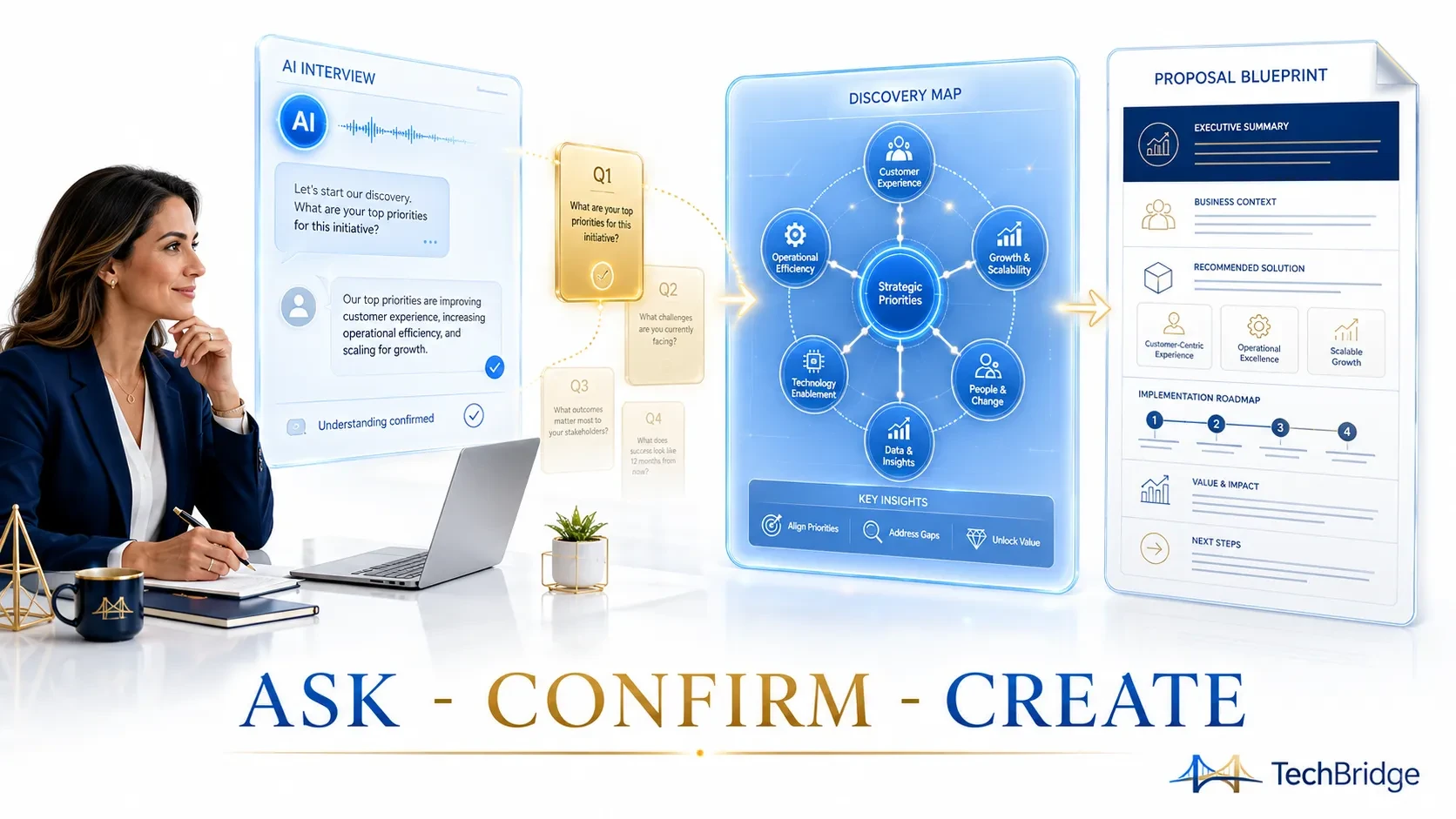
Turn a vague request into a structured discovery conversation before generating the deliverable.
Use a Reverse Interview. Instead of asking AI to immediately create a proposal, strategy, coaching plan, campaign, or analysis, instruct it to interview you first. Require one question at a time, explain why each question matters, and stop when it has enough information to produce the requested result. End the discovery phase with a summary of what it heard, unresolved assumptions, and your approval to proceed.
Most disappointing AI output begins with an underspecified request. Business leaders know the situation but often omit the context a model needs: decision criteria, audience maturity, constraints, existing assets, risk tolerance, success measures, and what has already failed. A Reverse Interview converts tacit knowledge into explicit requirements. It also mirrors the strongest consulting behavior: diagnose before prescribing.
The time investment occurs before drafting, but the savings appear in fewer rewrites and stronger decisions.
· Planning estimate: invest 8-15 minutes in discovery to avoid 30-90 minutes of revision on complex work.
· Reduce proposal, campaign, and content rework by surfacing constraints before the first draft.
· Improve client experience because recommendations reflect the actual situation rather than generic assumptions.
· Create a reusable discovery transcript that can inform scope, delegation, and measurement.
Small Business: A coach asks AI to conduct a discovery interview before creating a premium group program, including audience, transformation, delivery constraints, proof, pricing logic, and risk.
Enterprise: A transformation lead uses a Reverse Interview to define an AI use case before requesting a business case, identifying data, process volume, owners, controls, and success measures.
Personal Productivity: A professional lets AI ask about energy, deadlines, dependencies, and priorities before building a realistic weekly plan.
A consultant initially asked AI to create a statement of work from a short client description. The draft looked polished but assumed training, integration, and support that had never been discussed. The consultant restarted with a Reverse Interview. Twelve focused questions uncovered the decision maker, required systems, security review, timeline, excluded work, and success metric. The resulting proposal required one minor edit instead of a full rewrite.
Do not create the deliverable yet. First, conduct a Reverse Interview so you understand the business problem.
Requested deliverable: [PROPOSAL / STRATEGY / PLAN / CONTENT / ANALYSIS]
Desired business outcome: [OUTCOME]
Interview rules:
1. Ask one question at a time.
2. Ask no more than [10-15] questions unless I approve more.
3. Prioritize questions that could materially change the recommendation.
4. Briefly explain why each question matters.
5. Do not ask for information already provided.
6. If I do not know an answer, offer 2-3 practical options rather than inventing one.
Cover these areas when relevant:
- Audience or stakeholder
- Current process and pain point
- Desired outcome and success measure
- Constraints, budget, timeline, and resources
- Existing assets or systems
- Risk, privacy, security, or compliance
- What has already been tried
- Non-negotiables and exclusions
After the final question, provide:
A. What I heard
B. Confirmed requirements
C. Open assumptions
D. Recommended scope
E. A PROCEED / CLARIFY / ESCALATE status
Wait for my approval before creating the deliverable.
Ask the AI to rank its questions by decision impact before beginning. For client work, save the approved discovery summary as the front page of the project so every later deliverable traces back to the same requirements.
The common mistake is allowing the AI to ask a long questionnaire all at once. That creates rushed answers and missed follow-up questions. Ask one question at a time so each response can shape the next question. The second mistake is skipping the summary-and-approval step; without it, the AI may still proceed on a misunderstood premise.
· Material revisions per deliverable after the first draft.
· Requirement completeness: percentage of required fields confirmed before drafting.
· Cycle time from initial request to approved deliverable.
Do not use a general-purpose Reverse Interview to collect highly sensitive personal, health, financial, employment, or regulated information unless the tool and workflow are approved for that data. Do not let the interview become a substitute for direct stakeholder research when affected people need to be heard.
ChatGPT and Claude are especially effective for adaptive, one-question-at-a-time discovery. Microsoft Copilot is useful when the interview must be followed by work in Microsoft 365. Gemini is useful when the resulting plan will draw from Google Workspace files. A customized project, Gem, or notebook can preserve the interview method for repeated use, but the interview still needs a human to confirm what was understood.
posted in
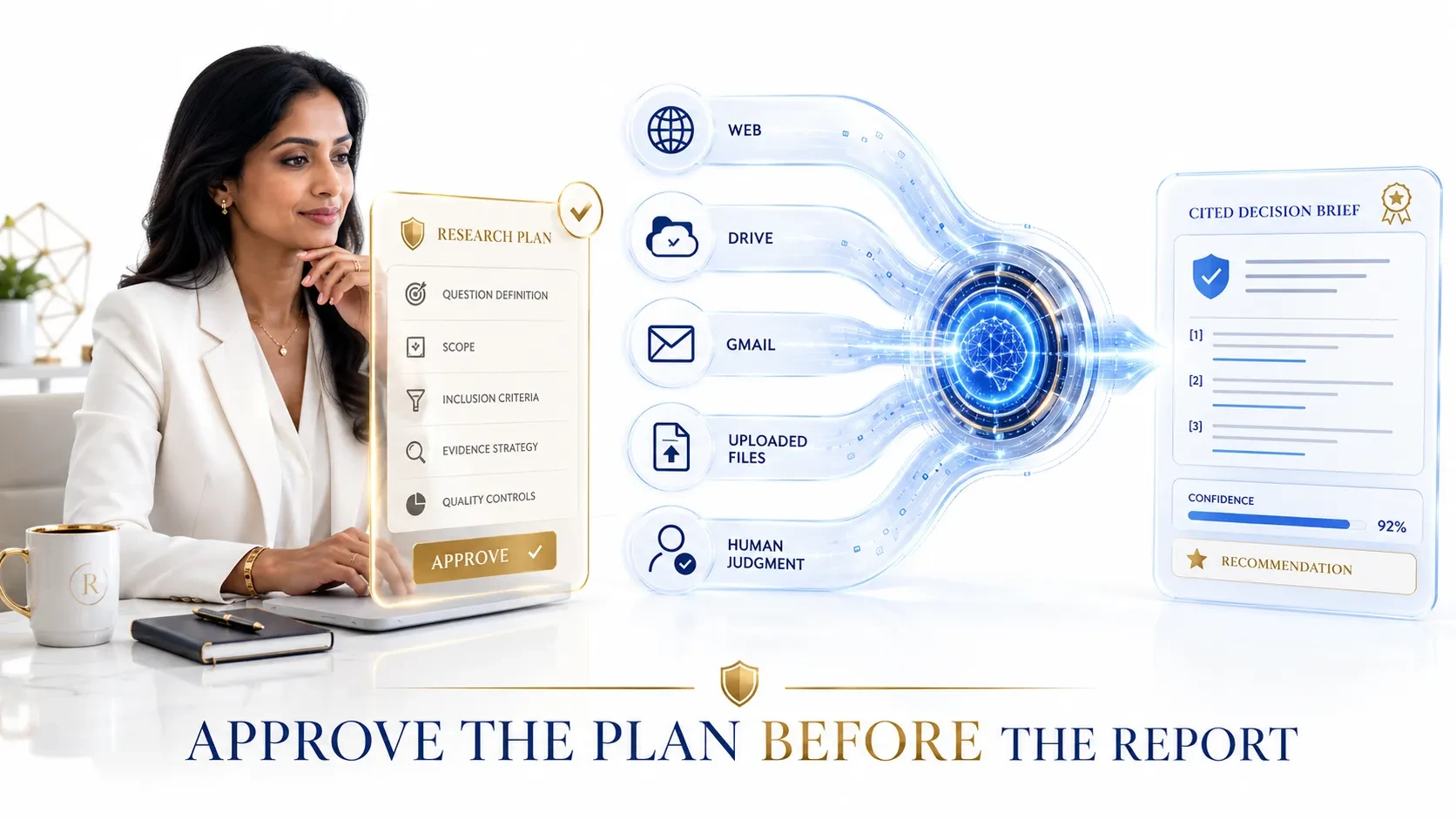
Use Gemini Deep Research to combine current web evidence with approved Gmail, Drive, and uploaded sources without blending fact, opinion, and assumption.
Start Deep Research with a decision question, not a broad topic. Select the sources Gemini may use, such as Google Search, approved Drive files, relevant Gmail, or uploaded documents. Review and edit the research plan before execution. Require a source register with date, publisher or owner, evidence type, and relevance. Tell Gemini to separate external evidence, internal evidence, interpretation, assumption, and recommendation. Ask for contradictory findings and missing evidence, then run a second pass that challenges the leading conclusion. Keep the final recommendation owned by a named human decision maker.
Research reports can look authoritative while hiding weak source selection, stale internal data, or untested assumptions. Gemini Deep Research creates value when the organization controls the question, source boundary, plan, evidence classes, and approval point. That makes it useful for market scans, partnership decisions, proposal research, policy comparisons, client briefings, and strategic planning without treating AI-generated synthesis as unquestioned truth.
Compare one research brief produced with an approved plan against the current manual or ad hoc process.
· Planning estimate: reduce initial research and synthesis time by 2-6 hours for a bounded executive brief.
· Improve decision quality by exposing conflicting evidence, source dates, and unknowns before recommendations are accepted.
· Reduce rework by aligning stakeholders on the research question and plan before collection begins.
· Lower citation risk by requiring a traceable evidence register and human verification of the most important claims.
Small Business: A consultant researches three target industries using current market sources plus approved Drive documents that describe the firm's capabilities and existing clients.
Enterprise: A strategy team compares regulatory, competitor, customer, and internal operating evidence before recommending a market-entry pilot.
Personal Productivity: A coach researches current workforce trends while keeping private client notes excluded and using only de-identified program themes as internal context.
A boutique advisory firm previously spent two days assembling a market-entry brief from web searches, old slide decks, and scattered emails. The principal used Deep Research with Google Search, three approved Drive files, and one current internal email thread. She edited the research plan to exclude consumer blogs, require sources from the past 18 months where possible, and include disconfirming evidence. The first draft took under three hours of total human effort. During review, the team rejected two weak claims, corrected one stale internal assumption, and delayed the recommendation until a customer interview closed the largest evidence gap. The time savings mattered, but the visible uncertainty produced the better decision.
Run a governed Deep Research process for this decision.
DECISION QUESTION
[ONE SPECIFIC BUSINESS DECISION]
DECISION OWNER
[NAME / ROLE]
APPROVED SOURCES
- Google Search: [YES / NO]
- Google Drive: [SPECIFIC FILES OR FOLDERS]
- Gmail: [SPECIFIC THREADS, PEOPLE, OR DATE RANGE]
- Uploaded files: [LIST]
- Excluded sources: [LIST]
SOURCE STANDARDS
- Prefer primary and authoritative sources.
- Record publication date and evidence date separately.
- Flag sources older than [TIME WINDOW].
- Do not treat marketing claims as independent validation.
- Do not infer internal facts that are absent from approved sources.
BEFORE RESEARCH
1. Restate the decision question.
2. Propose a research plan with workstreams and source types.
3. Identify likely evidence gaps and bias risks.
4. Wait for my approval or edits.
REPORT STRUCTURE
1. Executive summary
2. External evidence table
3. Internal evidence table
4. Conflicting findings
5. Assumptions and unknowns
6. Options with benefits, costs, and risks
7. Recommendation with confidence level
8. What would change the recommendation
9. Human decisions still required
10. Source register with direct citations
RED-TEAM PASS
Challenge the leading recommendation. Search for disconfirming evidence, alternative explanations, and stakeholder impacts that may have been missed.
Do not make the final decision. Present evidence and a decision-ready brief for the named owner.
Ask Gemini to maintain a claim ledger containing claim, evidence, source date, confidence, counterevidence, and human verifier. Have the decision owner sign off on the five most load-bearing claims before the brief is distributed. This turns citation review into an operating control rather than a last-minute proofreading task.
The common mistake is asking for “everything about” a market or topic. The result may be broad but not decision-ready. Another mistake is mixing personal Gmail, organizational Drive, public web sources, and uploaded files without stating which source class has authority. Define the decision, approve the research plan, limit access, separate evidence classes, and verify critical citations.
· Human research and synthesis hours per completed decision brief.
· Critical-claim verification rate and number of corrected or rejected claims before distribution.
· Decision cycle time from research request to approved next step.
Do not use Deep Research as a substitute for legal, financial, medical, regulatory, or security review. Avoid connecting personal or organizational sources without authorization and a clear need. Do not rely on a report when the evidence is highly time-sensitive, inaccessible, or dominated by unverifiable claims. Escalate material uncertainty to the responsible expert.
Gemini Deep Research is especially strong when the workflow benefits from Google Search plus approved Gmail and Drive context and the user wants to review the research plan. ChatGPT Deep Research is a strong alternative in an OpenAI environment. Claude Research can be effective for web and connector-based synthesis. NotebookLM is often better when the task must stay tightly bounded to a curated source set and evidence navigation is more important than broad web research.