posted in

The Evidence Boundary: Ask Only the Sources That Earned a Seat

Turn scattered policies, proposals, transcripts, and research into a citation-backed decision brief without letting unrelated files contaminate the answer.

The fastest way to improve an AI answer is often not a better prompt - it is a smaller, better source set.

Tip

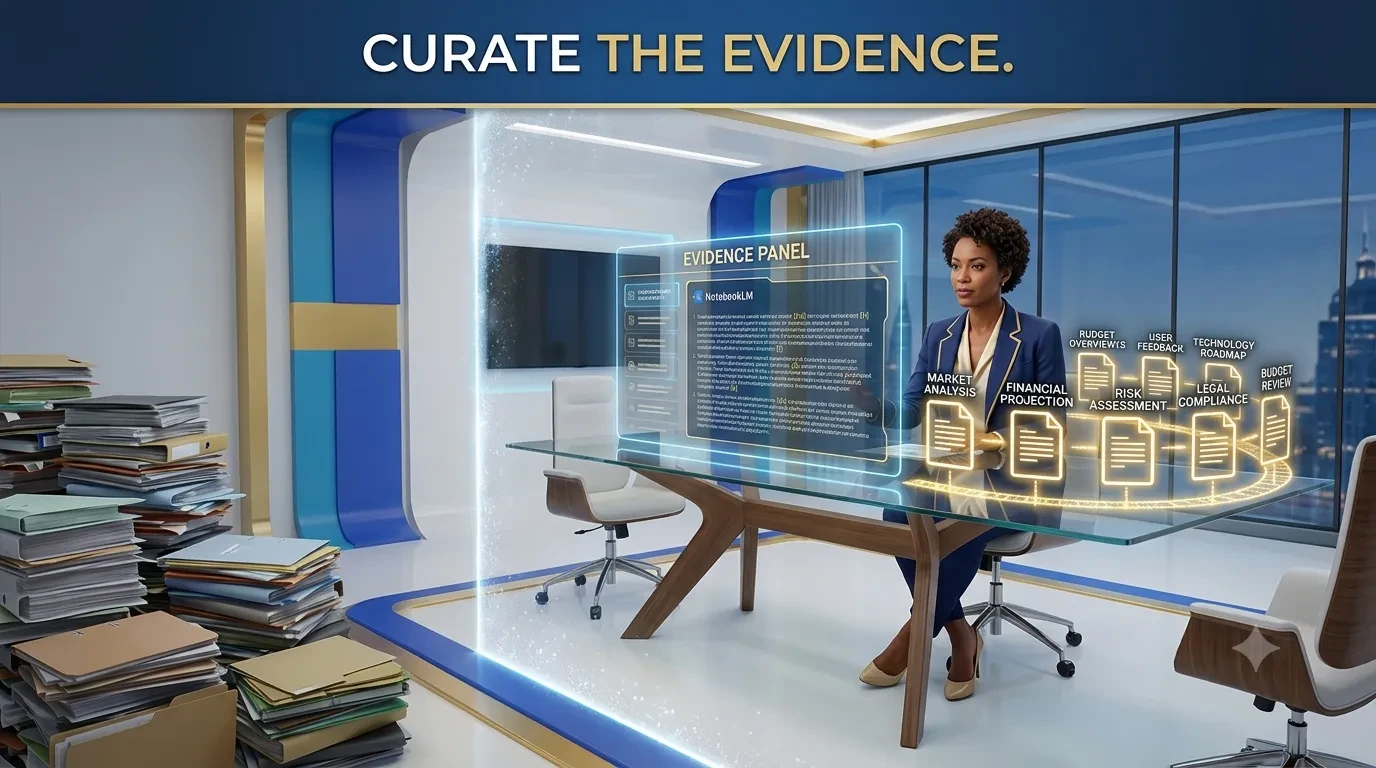
Create one notebook for one decision or recurring knowledge domain. Import only authoritative, current sources and label each source by owner, effective date, confidentiality, and purpose. Before asking a question, select the exact sources NotebookLM may use. Require the response to cite material claims, distinguish direct evidence from interpretation, identify contradictions, and list any unanswered questions. When the decision changes, create a new notebook or versioned source set instead of quietly mixing old and new context. Treat citations as navigation aids for human review, not as automatic proof that the conclusion is correct.

Why It Matters

Business leaders often receive polished summaries assembled from stale decks, informal notes, and sources written for different audiences. NotebookLM is most valuable when the source boundary is deliberate. A narrow, governed notebook helps a coach protect client context, helps a consultant preserve scope, and helps an SMB owner compare evidence without allowing general web knowledge or unrelated files to blur the decision. The business outcome is not merely a faster summary. It is a more reviewable path from evidence to action.

Business Impact

Pilot the notebook on one decision brief and compare it with the prior research and review process.

·    Planning estimate: save 60-180 minutes on source finding, cross-document comparison, and first-draft synthesis.

·    Reduce rework by showing the evidence behind each material claim and surfacing contradictions before the meeting.

·    Lower decision risk by separating source facts, human interpretation, assumptions, and recommendations.

·    Improve stakeholder confidence by making missing evidence visible instead of filling gaps with confident language.

Three Specific Use Cases

Small Business: A woman-owned consulting firm builds a pricing-decision notebook containing current service costs, win/loss notes, competitor pages, approved margin targets, and recent client feedback.

Enterprise: A program office creates a policy-impact notebook with the current policy, prior version, implementation guidance, meeting transcripts, and business-unit exceptions.

Personal Productivity: An executive coach creates a de-identified learning notebook from published research, the coach's framework, and approved exercises while keeping raw client notes outside the notebook.

Example

A 12-person advisory firm prepared quarterly service reviews by searching six folders and asking different team members what had changed. The managing partner created a notebook with the current service catalog, delivery metrics, client survey themes, change log, and approved financial targets. She selected only the relevant sources for each question and required a claim-evidence table with citations and an open-questions section. Preparation fell from nearly four hours to about 90 minutes. More importantly, the team caught a pricing recommendation that relied on an expired cost assumption before it reached the client.

Ready-to-Use Prompt

Create a source-bounded decision brief using only the selected notebook sources.

DECISION
[ONE SPECIFIC DECISION]

DECISION OWNER
[NAME / ROLE]

SOURCE RULES
1. Use only the sources currently selected in this notebook.
2. Cite every material factual claim inline.
3. Label each statement as EVIDENCE, INTERPRETATION, ASSUMPTION, or RECOMMENDATION.
4. Do not combine different clients, time periods, policies, or versions unless you explicitly explain the comparison.
5. Flag sources that appear stale, incomplete, contradictory, or outside scope.
6. Never invent a missing number, quote, commitment, or policy.

OUTPUT
A. Decision in one sentence
B. What the sources establish
C. Evidence table: claim | source | date | confidence | limitation
D. Contradictions and competing interpretations
E. Missing information
F. Options with benefits, costs, risks, and reversibility
G. Recommended next step for human approval
H. Five verification questions for the decision owner

Stop before finalizing any external communication or consequential decision.


Pro Tip

Create a Source Health note inside the notebook with source owner, effective date, review date, authority level, and superseded version. Ask NotebookLM to identify every answer that depends on a source past its review date. Google Drive sources can auto-sync, but the owner still must verify that the file is authoritative and that access remains appropriate.

Common Mistake

The common mistake is uploading everything "just in case." A large notebook can create false relevance and make contradictions difficult to detect. Another mistake is treating an inline citation as validation. A citation shows where the answer came from; it does not confirm that the source is current, unbiased, complete, or applicable. Curate first, then prompt.

Measure Success

·    Average time from question to reviewable decision brief.

·    Percentage of material claims with a verified, current source.

·    Number of stale-source, wrong-version, or unsupported-claim defects found before approval.

Avoid Using This When

Do not use the notebook as the final authority for legal, medical, financial, employment, credit, safety, or other high-consequence decisions. Do not upload confidential material unless the account, license, permissions, retention, and business need have been reviewed. Avoid combining multiple clients or unrelated engagements in one notebook.
The Evidence Boundary: Ask Only the Sources That Earned a Seat

You've reached the end of the posts

Back

posted in

NotebookLM (Gemini Notebook)

The Evidence Boundary: Ask Only the Sources That Earned a Seat

Turn scattered policies, proposals, transcripts, and research into a citation-backed decision brief without letting unrelated files contaminate the answer.

The fastest way to improve an AI answer is often not a better prompt - it is a smaller, better source set.

Tip

Create one notebook for one decision or recurring knowledge domain. Import only authoritative, current sources and label each source by owner, effective date, confidentiality, and purpose. Before asking a question, select the exact sources NotebookLM may use. Require the response to cite material claims, distinguish direct evidence from interpretation, identify contradictions, and list any unanswered questions. When the decision changes, create a new notebook or versioned source set instead of quietly mixing old and new context. Treat citations as navigation aids for human review, not as automatic proof that the conclusion is correct.

Why It Matters

Business leaders often receive polished summaries assembled from stale decks, informal notes, and sources written for different audiences. NotebookLM is most valuable when the source boundary is deliberate. A narrow, governed notebook helps a coach protect client context, helps a consultant preserve scope, and helps an SMB owner compare evidence without allowing general web knowledge or unrelated files to blur the decision. The business outcome is not merely a faster summary. It is a more reviewable path from evidence to action.

Business Impact

Pilot the notebook on one decision brief and compare it with the prior research and review process.

·    Planning estimate: save 60-180 minutes on source finding, cross-document comparison, and first-draft synthesis.

·    Reduce rework by showing the evidence behind each material claim and surfacing contradictions before the meeting.

·    Lower decision risk by separating source facts, human interpretation, assumptions, and recommendations.

·    Improve stakeholder confidence by making missing evidence visible instead of filling gaps with confident language.

Three Specific Use Cases

Small Business: A woman-owned consulting firm builds a pricing-decision notebook containing current service costs, win/loss notes, competitor pages, approved margin targets, and recent client feedback.

Enterprise: A program office creates a policy-impact notebook with the current policy, prior version, implementation guidance, meeting transcripts, and business-unit exceptions.

Personal Productivity: An executive coach creates a de-identified learning notebook from published research, the coach's framework, and approved exercises while keeping raw client notes outside the notebook.

Example

A 12-person advisory firm prepared quarterly service reviews by searching six folders and asking different team members what had changed. The managing partner created a notebook with the current service catalog, delivery metrics, client survey themes, change log, and approved financial targets. She selected only the relevant sources for each question and required a claim-evidence table with citations and an open-questions section. Preparation fell from nearly four hours to about 90 minutes. More importantly, the team caught a pricing recommendation that relied on an expired cost assumption before it reached the client.

Ready-to-Use Prompt

Create a source-bounded decision brief using only the selected notebook sources.

DECISION
[ONE SPECIFIC DECISION]

DECISION OWNER
[NAME / ROLE]

SOURCE RULES
1. Use only the sources currently selected in this notebook.
2. Cite every material factual claim inline.
3. Label each statement as EVIDENCE, INTERPRETATION, ASSUMPTION, or RECOMMENDATION.
4. Do not combine different clients, time periods, policies, or versions unless you explicitly explain the comparison.
5. Flag sources that appear stale, incomplete, contradictory, or outside scope.
6. Never invent a missing number, quote, commitment, or policy.

OUTPUT
A. Decision in one sentence
B. What the sources establish
C. Evidence table: claim | source | date | confidence | limitation
D. Contradictions and competing interpretations
E. Missing information
F. Options with benefits, costs, risks, and reversibility
G. Recommended next step for human approval
H. Five verification questions for the decision owner

Stop before finalizing any external communication or consequential decision.


Pro Tip

Create a Source Health note inside the notebook with source owner, effective date, review date, authority level, and superseded version. Ask NotebookLM to identify every answer that depends on a source past its review date. Google Drive sources can auto-sync, but the owner still must verify that the file is authoritative and that access remains appropriate.

Common Mistake

The common mistake is uploading everything "just in case." A large notebook can create false relevance and make contradictions difficult to detect. Another mistake is treating an inline citation as validation. A citation shows where the answer came from; it does not confirm that the source is current, unbiased, complete, or applicable. Curate first, then prompt.

Measure Success

·    Average time from question to reviewable decision brief.

·    Percentage of material claims with a verified, current source.

·    Number of stale-source, wrong-version, or unsupported-claim defects found before approval.

Avoid Using This When

Do not use the notebook as the final authority for legal, medical, financial, employment, credit, safety, or other high-consequence decisions. Do not upload confidential material unless the account, license, permissions, retention, and business need have been reviewed. Avoid combining multiple clients or unrelated engagements in one notebook.

The Evidence Boundary: Ask Only the Sources That Earned a Seat